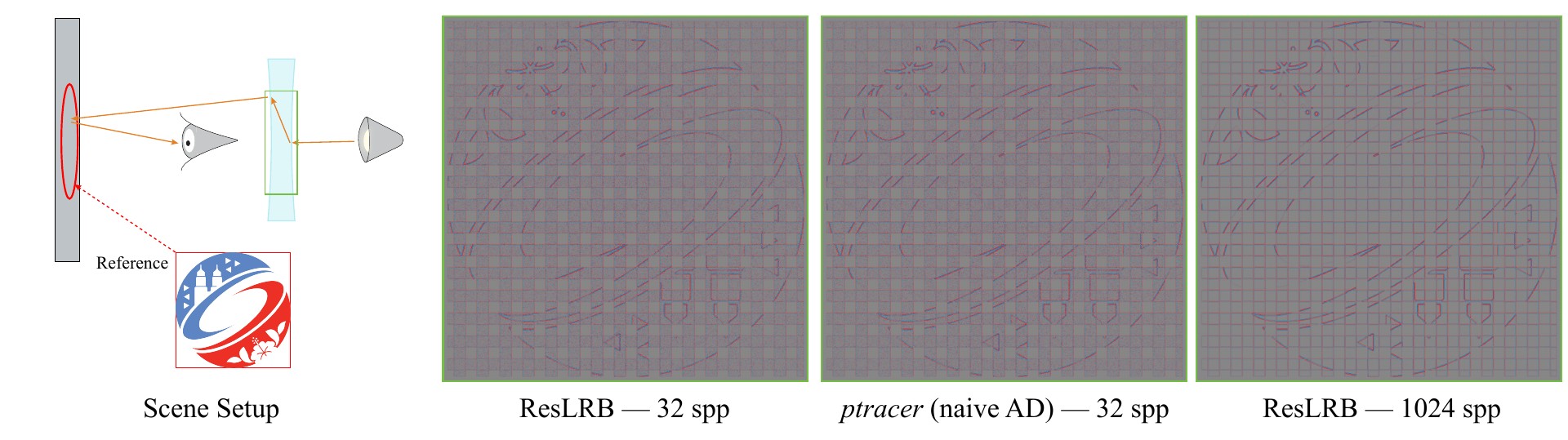
We describe Reservoir Light Replay Backpropagation (ResLRB), a method for reverse-mode differentiable light tracing whose memory is constant in path length and in the number of sensor connections per light path. Naive automatic differentiation of a light tracer records a computation graph that grows with the number of valid sensor connections along each path, since flux can be splatted from every scattering vertex; adjoint path replay removes the analogous dependence on depth for viewpoint path tracing, but its non-branching structure does not extend to the splatting case. We compress the adjoint graph during the primal pass by stochastically retaining a single representative sensor connection per light path via a streaming weighted reservoir. The adjoint pass reconstructs the path deterministically by replaying its pseudorandom number sequence and backpropagates only through the retained connection, yielding an unbiased gradient estimator whose peak memory is that of differentiating a single scattering event.
Stochastic Graph Compression for Constant-Memory Differentiable Light Tracing
SIGGRAPH Asia Technical Communications, 2026
Abstract